

STARR GYM FOR THE BRAIN
TENSION AND TRAUMA
RELEASE EXERCISES (TRE)
Home STARR EXERCISES – TENSION AND TRAUMA RELEASE EXERCISES (TRE)
SETTINGS, ENTER INVITE CODE: MASSCUE-FREE-WEEK
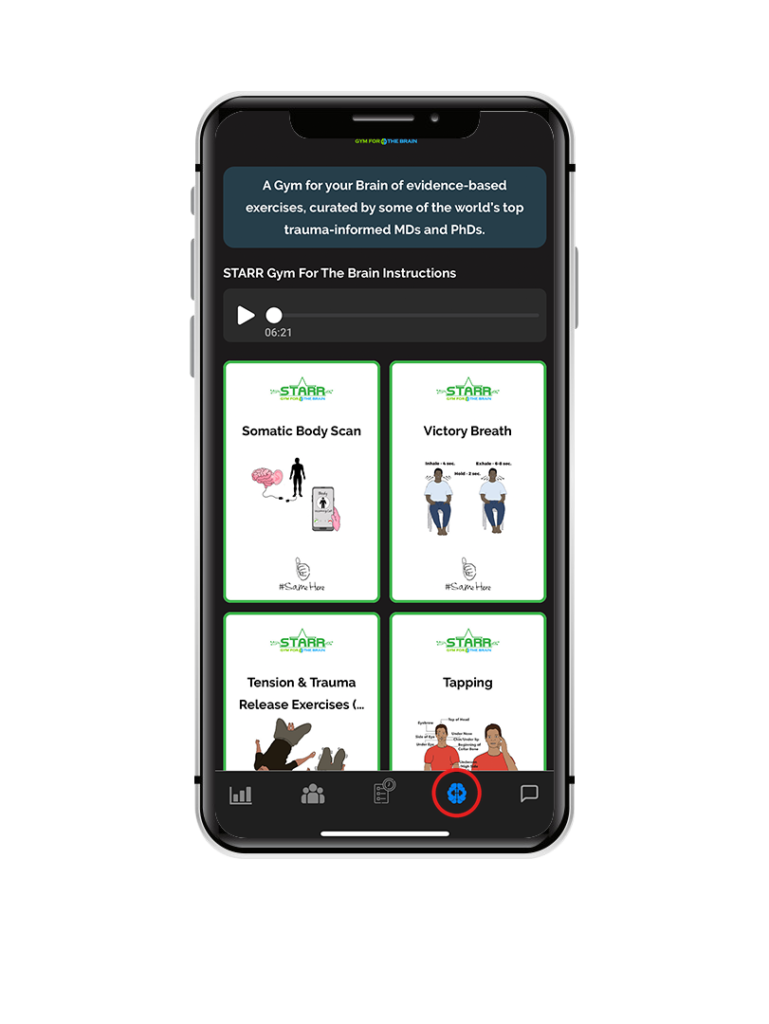
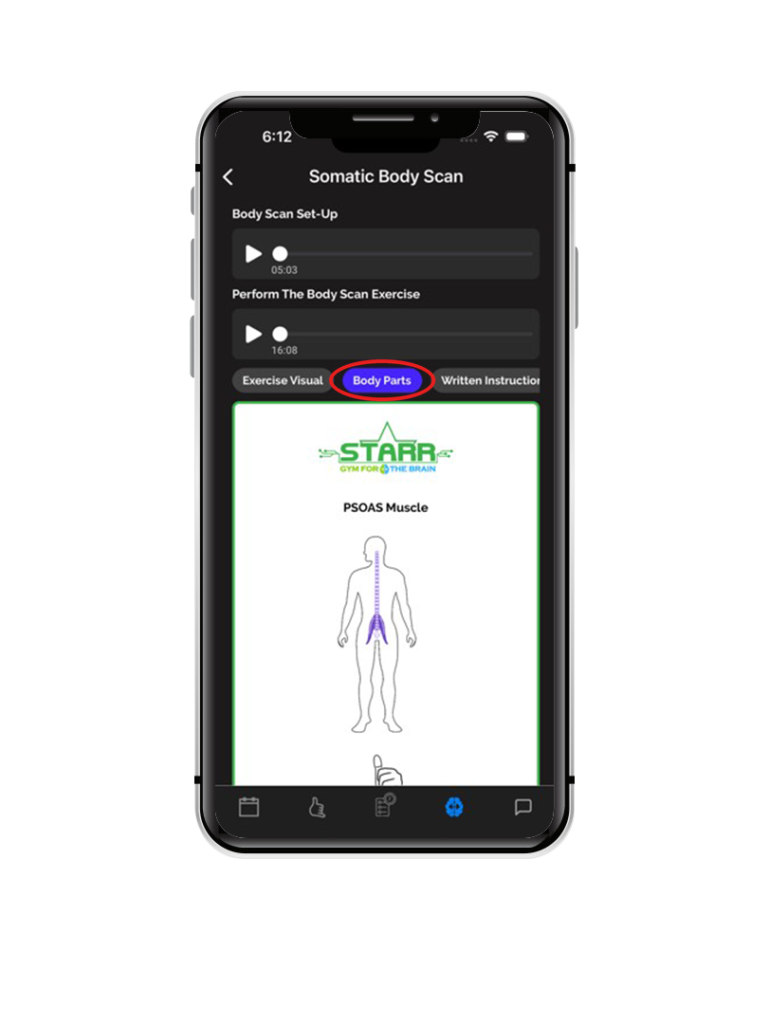
1) Click on the “Brain Gym” icon in the bottom of the navigation bar, 2nd from the right side and select the card for the exercise station you are visiting.
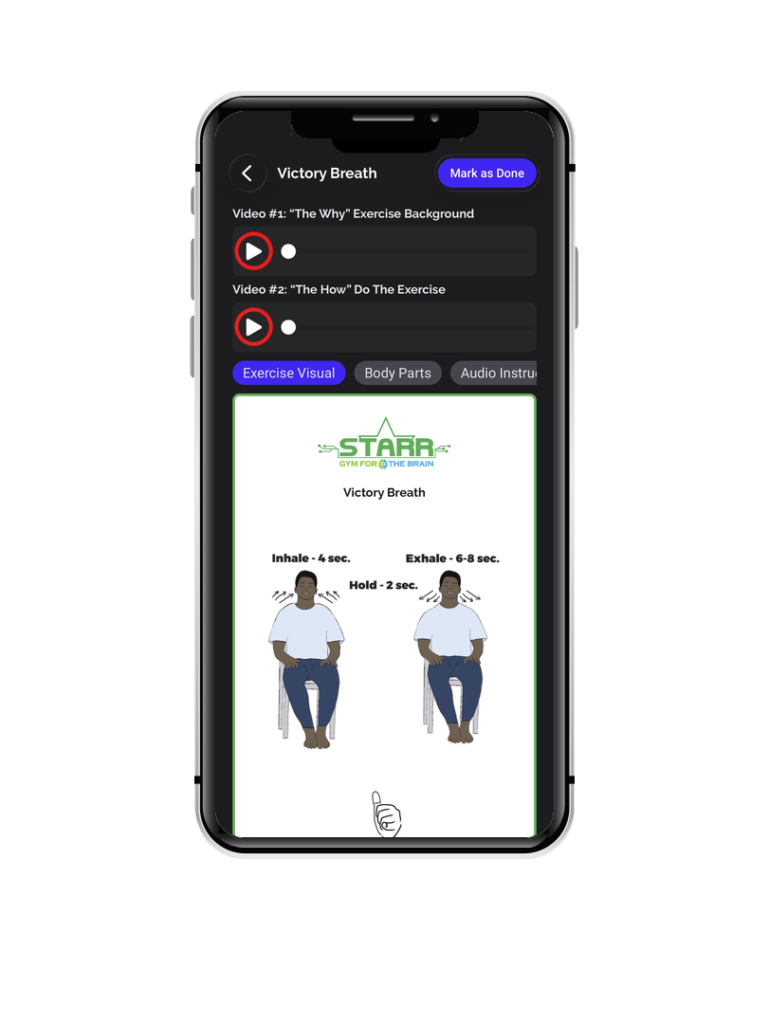
2) Click on one or both videos on top to play either the background understanding or to try the instructional steps of the exercise.
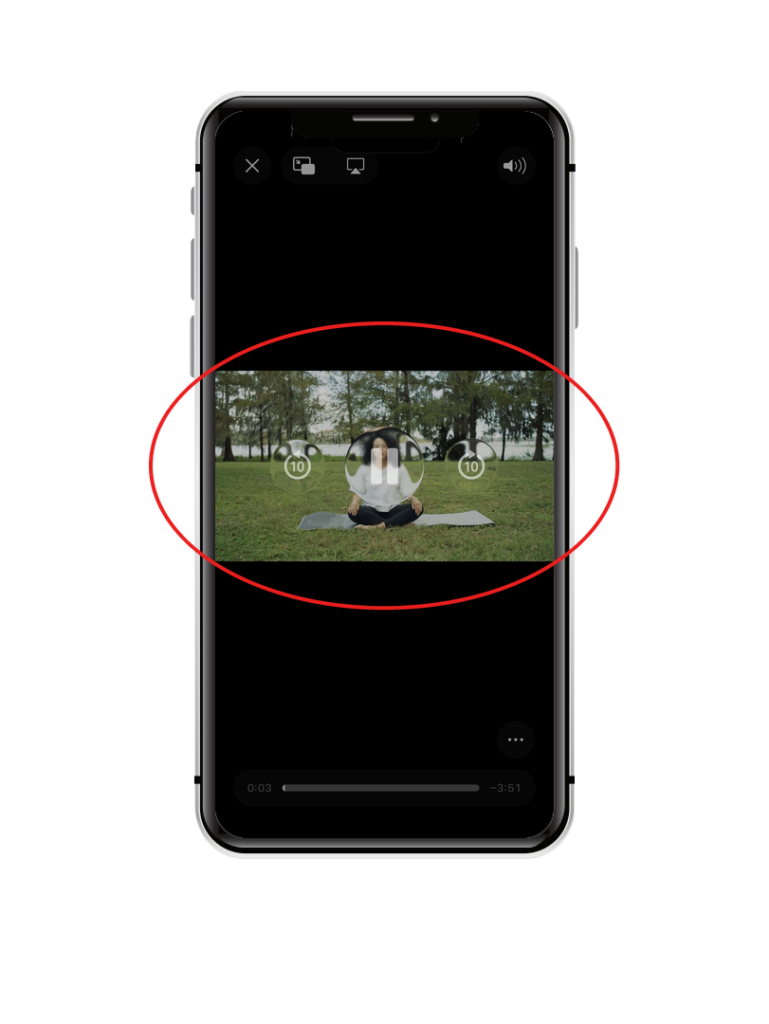
3) Play the videos and follow along with the instructions. A written set of instructions is below. You can advance or rewind the videos as well.
4) Once you become comfortable try out other features like the “Body Parts” visuals and audio explanations, or the “Routines” section – middle icon.
HOW IT'S DONE (STEP-BY-STEP)
• Many people have great success being able to induce the release mechanism with this one simple TRE exercise
• This one particular exercise we will do here, is designed to, at first – gently stretch and mildly stress specific muscle groups in our body
• Begin by laying passively on your back, on the floor (or a mat) in a specific position known as a reclined butterfly position in yoga – (your head, neck, shoulders, back, arms, hands, and bottom are all resting on the floor
• At the same time, you bend your knees open and touch the bottoms of your feet, together – (the outsides of your feet will also be against the floor in this position)
• Allow your knees to relax open, so they fall as close to the floor as they can, naturally
• From this relaxed position, raise your knees about one inch, in the direction of bringing them closer to one another – hold that position for two minutes
• This process of slowly closing the knees, one inch closer at a time, every two minutes (while keeping the back of your feet on the ground), begins to stretch and fatigued certain muscle groups and – evokes the mild vibration in the body
• You can keep moving the knees one inch closer until you really begin to feel the natural vibration kick in; it is okay if the vibration starts sooner than you expected
• As you continue this process, the vibration will get stronger and begin to move from your legs into your hips and up your spinal column; at this point, the vibration is happening naturally, and you will no longer have to think about holding your knees in any specific position or any specific distance off the ground
• When your knees are about 10 inches apart at their peak (or when the vibrations have started, even before your knees have gotten that close), you can then turn the bottoms of your feet flat onto the floor, toes pointed forward, and move your feet about 5 inches apart from each other – this will produce the look of a slight V-shape going from your pelvis up each knee as you look down to them from your position still laying on your back
• Once the vibration is activated, and you are laying in this relaxed position (much easier with your feet flat on the ground), you can do things like: watch TV, talk with friends, or simply lay in silence enjoying the sensation as it spreads to different areas of your body; it requires no concentration or effort on your part once the vibration naturally begins
• Just relax and enjoy your body’s ability to restore itself to a calm and relaxed state by naturally releasing stored tension and trauma
• Typically, we want to do these exercises for at least six minutes (once the vibrations have started) and can continue so long as your body does not start to feel hurt or overly exhausted from the vibrations – it’s meant to be a releasing and restorative practice
• When you are finished, you can push your knees back together, hold them in this position, take four deep breaths in and out of your nose, with your mouth closed (four seconds in and four seconds out), roll over to the side you are most comfortable on, and push yourself off the ground to a standing position when you feel ready
BODY PARTS THIS EXERCISE WORKS ON:
Tension & Trauma Releasing Exercises (TRE) can be thought of as a way to unravel the deep-seated tension that accumulates in our bodies due to how we hold and brace ourselves as we experience chronic stress and trauma. By practicing TRE, we activate a natural process that counteracts how we instinctively tighten and curl inward when confronted with overwhelming life challenges or distressing emotions.
This tension often centers in the psoas muscle-which are located deep in the pelvis, and connected to the muscles, fascia, and ligaments of the stomach, lower back, neck, and even up to the masseter muscles of the jaw. Why the psoas muscle? Think of how we clench our teeth and curl into a ball during an emotionally intense event, or when bracing against stress-whether after a tough day or in the face of sudden bad news.
When stress triggers the psoas to tighten, it pulls from its position in our pelvic area, on upward through this interconnected web, drawing the body into a fetal position with shoulders hunched, abdomen contracted, and jaw locked. Over time, this constant tension leads to muscle pain in these regions, which is why so many experience chronic discomfort in the lower back, neck, or jaw-not ourselves in the face of pressures.
When the psoas and its connected muscles remain tense for prolonged periods, pain emerges, and the brain responds by producing endogenous opioids-natural pain-relieving chemicals-to dull this discomfort. While this eases the ache, it also leaves us feeling numb, dissociated, and detached, as if we’re outside our bodies or our surroundings feel unreal. This pain also signals to the nervous system that something happening around us is not safe, and prioritizes escape or relief over the body’s innate healing and rejuvenating processes.
Left unchecked, this buildup of stress and tension can push us toward a breaking point, where the body instinctively trembles it out through crying-shaking uncontrollably with chattering teeth and a quivering stomach until the pressure releases.
TRE offers a way to bring about this tremor mechanism intentionally. By inducing gentle tremors in the psoas muscle, often initiated through postures like the butterfly pose to get started, TRE loosens tension throughout the fascia and connected muscle groups. Picture it as the opposite of that clenched, curled-up state-like shaking out a knotted rope to let it lie flat.
These tremors not only reduce muscle tension and alleviate the need for opioid production, helping us feel less numb and more present, but they also spark a reflex loop from the spinal column to the brainstem. This pulsating loop activates neural circuits of ours that recalibrate and reorganize the central nervous system-enhancing its ability to communicate effectively throughout our body and restore balance.
TRE provides additional benefits through its postures, such as the butterfly pose, which engages the cerebellum —a structure at the lower posterior part of the brain that coordinates balance and movement. When the cerebellum isn’t functioning optimally, we lean harder on other senses like hearing and vision to stay balanced, which can lead to light sensitivity, sound sensitivity, and overcompensation from the nerves in our hands and feet.
The balanced positioning in TRE exercises the cerebellum, taking the burden off these overworked systems, promoting stability, and reducing sensory overload. By practicing TRE, you not only unwind the physical and emotional bracing but also reawaken the body’s natural ability to heal and thrive, leaving you more grounded and connected
ACTUAL HEALTH BENEFITS
• Releases chronic muscular tension
• Calms down our nervous system
• Improves flexibility
• Improves sleep quality
• Improves body and mind connection and awareness