

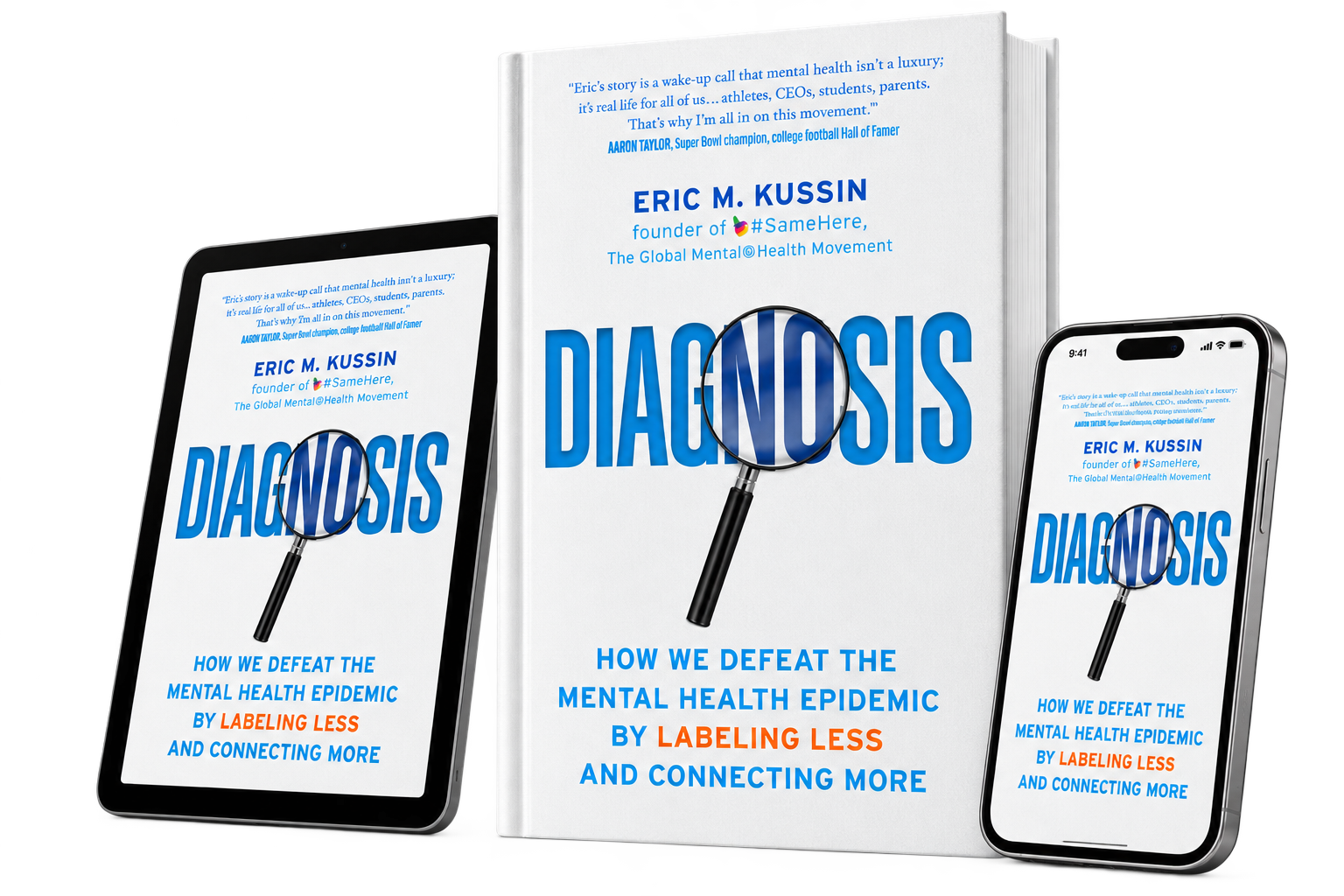
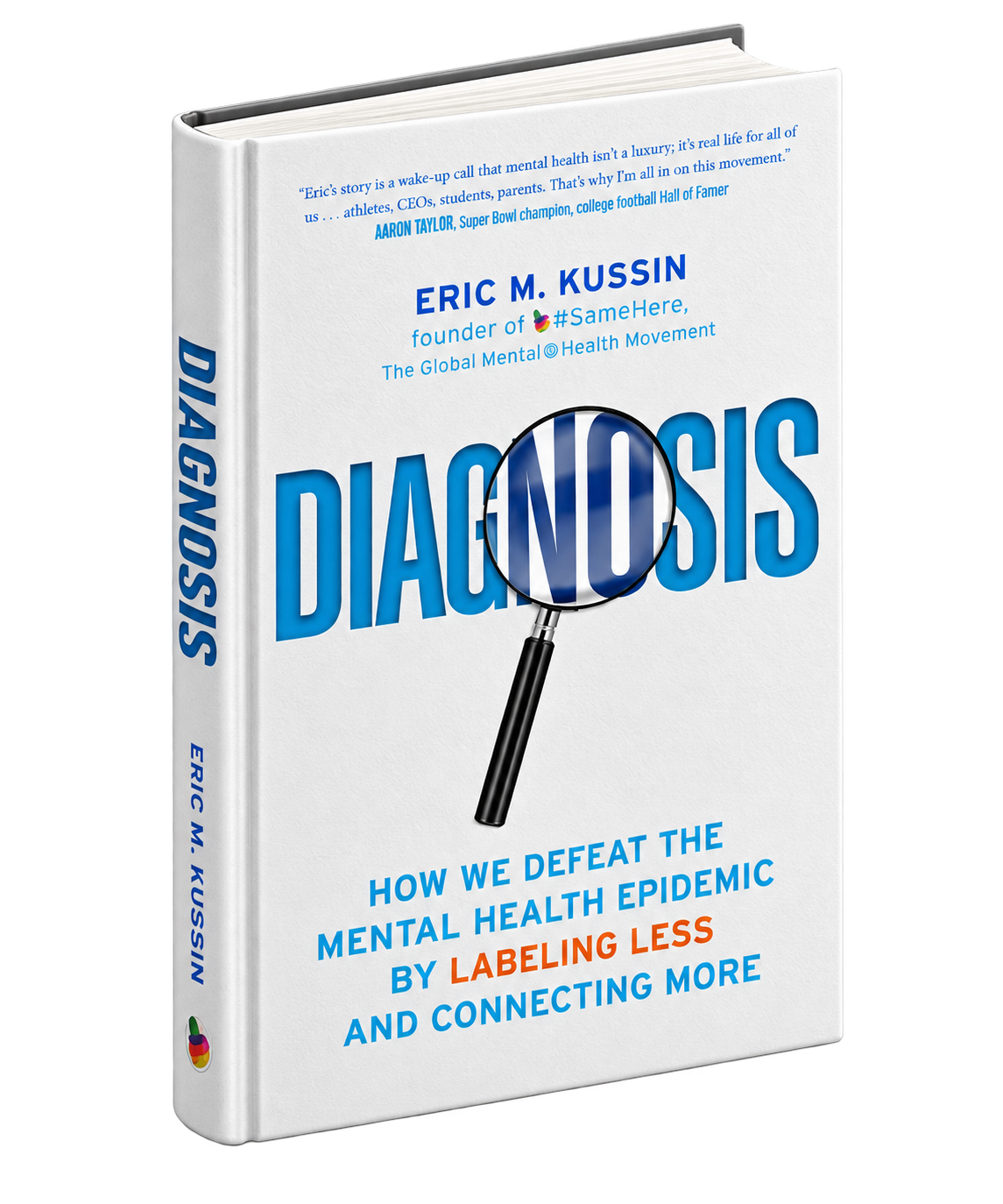
Diagnosis
How We Defeat the Mental Health Epidemic by Labeling Less and Connecting More
ON SALE NOVEMBER 10
We are living through the loudest mental health conversation in human history — and the least effective one. Awareness has never been higher. Outcomes have never been worse.
Diagnosis argues that the system built to help us is quietly making things harder: sorting people into labels instead of treating the root causes underneath them, medicating symptoms instead of resolving the issues at the source of what produces them, and telling “1 in 5,” 20% of the population, they have “a mental illness” while leaving the other 80% separated from that 20%, and with no language for the very real struggles life brings to everyone.
Eric Kussin knows this system from the inside — as a rising sports business executive who lost two and a half years of his life to a mental health crisis that the conventional care model could not touch, and as the founder of a global movement now trusted by professional sports franchises, Fortune 500 companies, universities, and the U.S. military. Diagnosis is his account of what actually works: the uncovering the neuroscience and making it digestible for the masses, learning the practices that regulate the nervous system rather than mask its signals, and a offering a simple reframe — labeling less, connecting more — one that is a decade in – changing culture in schools, locker rooms, and boardrooms around the world.
This is not a book about who has a mental illness. It’s a book about what to do with a mind and body that’s experienced chronic stress and trauma — because that’s all of us – “5 out of 5.”





THE BIGGER TRUTH
Mental health isn't just a 1-in-5 conversation.
It's 5 out of 5.
STRESS. TRAUMA. BURNOUT. ISOLATION. LIFE.
GET YOUR COPY
SIGNED. PERSONALIZED. OR ORDERED IN BULK.
Whether you’re looking for an autographed copy of Diagnosis, a personalized book, or copies for your organization, school, team, or event, submit your request below.
Why Diagnosis?
WHY THIS BOOK, WHY NOW
Mental health awareness campaigns are everywhere. Ribbons, hashtags, corporate wellness days, celebrity confessionals. And yet by nearly every measure — burnout, isolation, suicide, and overdose — we are worse off than we were before the awareness boom began.
Something isn’t working, and it isn’t a lack of attention. It’s the message itself.
For a generation, the mental health conversation has been built around a single, well-meaning statistic: 1 in 5 people live with a mental illness. That number was meant to “reduce stigma.” Instead, it quietly told the other 80% of us that whatever we were feeling — the grief, the burnout, the panic, the identity crisis — didn’t count. It wasn’t a “real” mental health issue. It was just life.
And even within the 20%, the label often solves less than it promises. A diagnosis can bring real relief at first — a name for the chaos, an explanation that isn’t “something’s wrong with you.” But a label isn’t the same as a source. Too many people who receive one find themselves stalled there: understood just enough to stop asking why, but never actually led back to what lies underneath it. And rather than uniting the 20% with each other, different labels tend to divide people further — anxiety in one room, bipolar in another, PTSD in a third, etc. — each isolated inside its own diagnosis instead of recognizing the same dysregulated nervous system, which lead to these symptom clusters, underneath all of them.
Diagnosis rejects that math. Life doesn’t spare 80% of us. Chronic stress and trauma from challenging life events touch “5 out of 5” people — no exceptions, no immunity, no matter how much success, money, or armor you’ve built around yourself. Eric Kussin learned that the hardest way: at the exact moment his career in professional sports was accelerating fastest, believing he was in that protected “80%,” his own nervous system shut the whole thing down, and the labels the healthcare system offered him didn’t lead to healing — they led to more questions.
What did lead to healing was root-cause work: understanding what stress and trauma actually do to the physiology in the body, and using tools — some centuries old, some invented in the last decade by the very doctors and researchers who appear in this book — to intervene where the damage actually lives, in the body, not just in the “DSM” – Diagnostic and Statistical Manual of Mental Disorders that is used almost as the Bible by the conventional model.
As the mental health conversation reaches every school, team, and workplace in the country, Diagnosis offers something the moment is missing: not another awareness campaign, but a working blueprint — that’s been used by the NFL, the NHL, the NYPD, the Department of Defense, and college campuses across the country — for what to actually do next.
01
THE LABEL
How we currently categorize mental health as a society.
02
THE ROOT
What’s happening underneath the symptoms and labels.
03
THE CONNECTION
The magic that happens when we treat the root and stop separating people.
Meet The Author
ERIC KUSSIN
From professional sports to mental health advocacy.
- 15 years in professional sports
- Founder of #SameHere Global
- Author of DIAGNOSIS
Eric Kussin, a magna cum laude graduate of Cornell University, built a 15-year career in professional sports — beginning at the NBA League Office, where he was promoted four times in his first five years.
He advanced through leadership roles with the Chicago Sky, Phoenix Suns (where he won a title with the Phoenix Mercury), and New Jersey Devils (where his team advanced to the Stanley Cup Finals in 2012), before becoming the Chief Revenue Officer with the Florida Panthers under the ownership group that helped lay the foundation for the franchise’s run to three consecutive Stanley Cup Final appearances and two championships.
At the exact moment his career was accelerating fastest, a debilitating mental health crisis stopped it cold — leaving Eric bed-bound for over two and a half years, back home with his parents’ support. After a mental health care system built on labels and medication failed to address what was actually happening in his body, Eric found his way to integrative, root-cause practices that finally led to a healing journey.
Rather than return to sports, Eric felt called to build something the world needed. In 2017, he founded #SameHere Global — The Global Mental Health Movement, built around a single correction to the way we talk about mental health: not 1 in 5 living with a diagnosable illness, but 5 out of 5 of us navigating the chronic stress and trauma that accumulates as a result of the twist and turns of being alive.
The #SameHere Global movement now unites athletes, celebrities, media members, expert practitioners, and advocates around a shared mission of normalizing the conversation, with programs reaching U.S. college campuses, K-12 schools, corporate offices, professional sports organizations, and government agencies nationwide. Eric was recently invited to Korea to present #SameHere Global’s programs to U.S. service members across the Korean Peninsula, bringing along NFL players and medical doctors from his team.
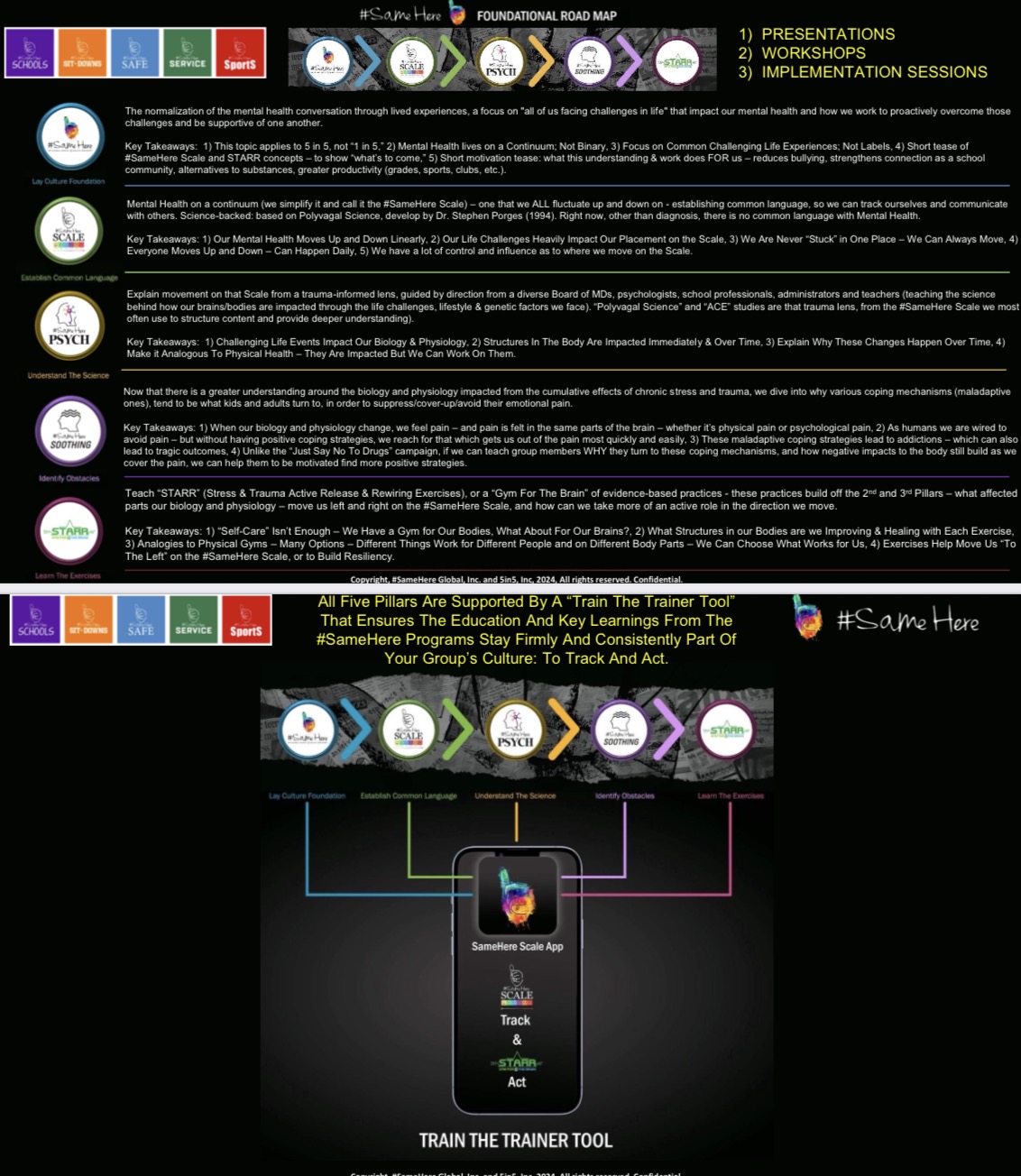
To make daily mental health monitoring and nervous system regulation accessible to educators and students, Eric launched the SameHere Scale app.
Diagnosis: How We Defeat the Mental Health Epidemic by Labeling Less and Connecting More is his first book.
While leading #SameHere Global, Eric continues to consult for professional sports teams and leagues on ticket and sponsorship strategy — a reminder that his path to this work began not in a clinic, but on the field, in the locker room, and in the arena.
PRE-ORDER DIAGNOSIS
Be among the first to experience Diagnosis: How We Defeat the Mental Health Epidemic by Labeling Less and Connecting More—a thought-provoking exploration of mental health, human connection, and the way we understand one another. Pre-order your copy today from your preferred bookseller
Praise
What People Are Saying?
SPEAKING & PROGRAMS
Bring the Conversation
to Your Organization
- Schools
- Universities
- Sports
- Companies
- Military & First Responders
- 500+ keynotes and programs
Trusted by:
















The Movement